skip to main |
skip to sidebar
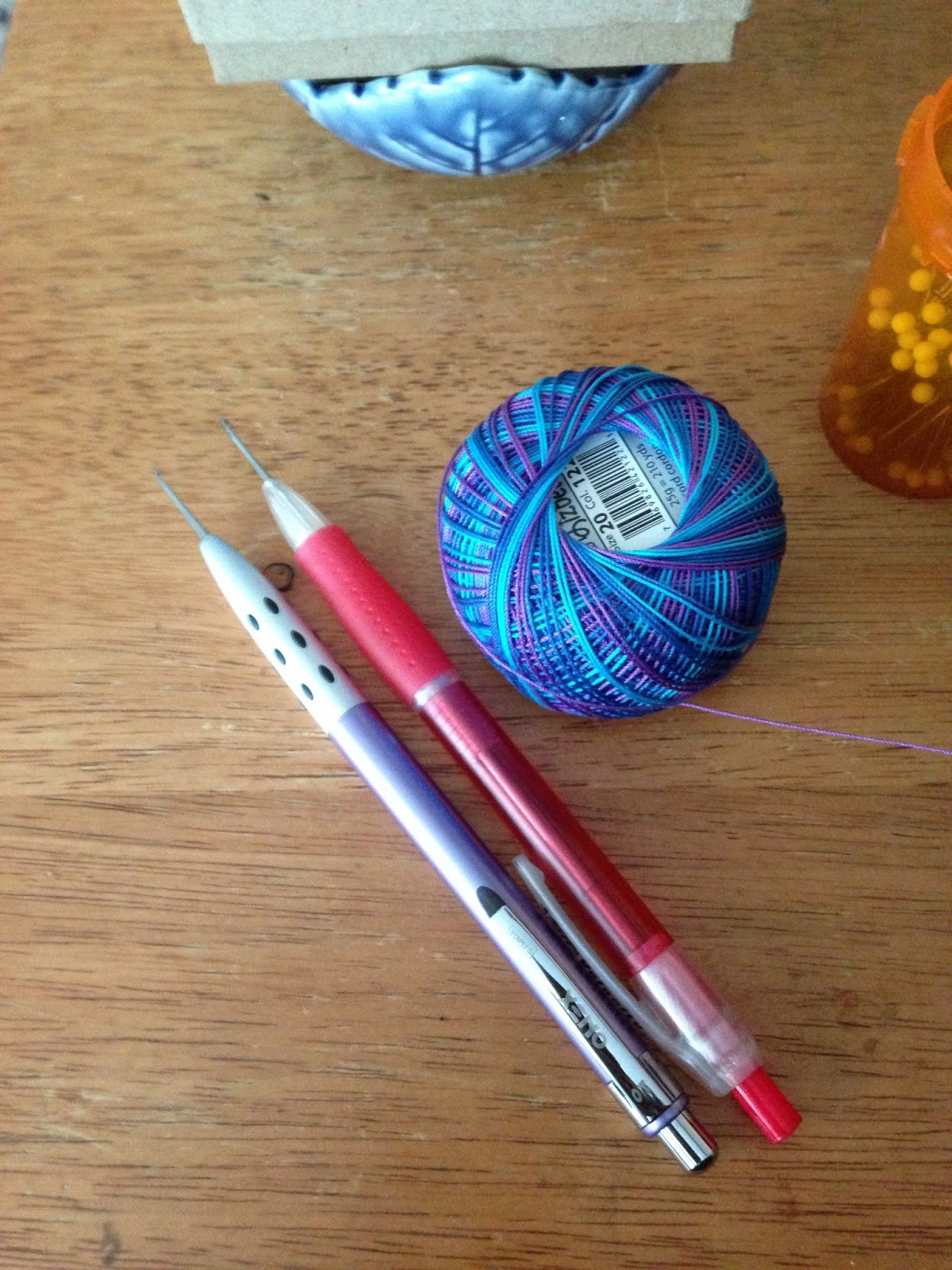
Those are not pens. Those are fine steel crochet hooks shown in the photo. This is my solution to the problem of losing small steel crochet hooks. I have a couple of these floating around. I've had them for years and have no idea how I acquired them. None. Most likely, I got the hooks in a collection of other knitting needles and crochet hooks that I have acquired. Some were given to me and I once or twice bought assortments of tools on eBay.
Generally, I don't do much crochet. I certainly haven't done any crochet with fine cotton in many years. These hooks have been languishing in drawers or pencil cups. Until I learned how to tat.
Tatted motifs are joined by drawing a thread through a tiny loop called a picot. A small steel crochet hook is the BEST tool to perform this function. Yes, you can use the pointed "pick" end of some tatting shuttles for this purpose. You can also go bats**t insane in the process. (It works for larger thread/larger picots.)
Small steel crochet hooks, in their naked state, tend to get lost. I drop them. The cat helps me drop them. If I put them in a bag, plastic or fabric, they tend to poke right through the material. Irritating.
It is perfectly possible to buy crochet hooks with large, "ergonomic" handle and neat little caps. You will also pay a fortune for those hooks. A barenaked set of steel hooks costs about $7.00-$14.00, depending on the number of hooks. The same set of steel hooks in plastic handles, suddenly costs $60.00. Not happening. My current solution is to ransack the ballpoint pen supply in my household, substituting steel hooks, for the ink cartridge. So far, I've found two or three casings that work with the hooks. Eventually, I might trim the hooks down to make them retractable. That's a future project. For now, I'm happy that the hooks have a nice handle, are easy to see and can be clipped to a pattern. They don't poke through bags nearly as much, now. One casing, not shown, uses the pen cap to cover the hook. I love inexpensive solutions.
This is my tatting set-up. At the moment I am just sick of knitting. That seems to happen every so often.
Last summer I finally, finally got serious and taught myself to tat for real. After a good nine months of neglect, I've picked it up and am making some progress. Of course, we're talking about...expensive progress. I just had to buy few more tatting books. Worth it.
I've finally discovered the world of modern tatting patterns. The newer sensibilities are much more to my taste. One reason I didn't put any effort into tatting before was that the designs were just dreary, and old patterns tend to be written out in long hand.
I like charted knitting patterns and the same is true for tatting patterns.
The photo shows one of my two tatting boxes. Both boxes are metal lunchboxes. One box, not shown, simply holds my balls of various cotton threads. The box in the photo, gets all the action. The storage compartment is filled with my tools, tatting shuttles, scissors, pins, tapestry needles, and small steel crochet hooks. I have fitted the lid of the lunchbox with a cork board, to use in arranging or blocking pieces.
At the moment, you can see a completed bookmark pinned out, made from a pattern by Tat-a-renda. I liked the look of just the first two rounds of the pattern, so I omitted the last round of the pattern.
My current sample, shown pinned at the lower left corner, i s trefoil edging. I'm making that to use up the thread left on the shuttle from the bookmark. Thread used is a size 20, Lizbeth Cotton cord. The cord is a variegated mix of pretty blues and violets that looks great until you actually use it in a project. Just as in knitting, variegated cords aren't suitable for all projects. The color distribution looks better in the trefoil edging than in the bookmark. Complicated pieces will be made in solid or tonal cords from now on.
I have a fairly new coworker named Bonnie. She was hired last Autumn to replace someone who relocated to another state. A few days ago, I found Bonnie is tears at her desk. Her daughter had been deployed to Afghanistan and was en route. The travel time is about 48 hours total. It broke my heart to see Bonnie in such distress, but I am relieved to report that her daughter arrived safely. She will be away for about six months.
Yesterday, I wore a knit scarf to work. The pattern is called Augustine and is shown in detail above. The triangular scarf is knit with a fingering-weight wool sock yarn, KnitPicks' Imagination. The color is called Looking Glass. Bonnie admired the scarf and I offered to make something for her. I had already planned to make something, planning for have it ready for her birthday or Christmas. In other words,
plenty of time.
I should KNOW better by now. Don't try this at home. I think from now on, I will keep my mouth shut and knit things as a surprise, on my own terms. When I asked Bonnie what she might like, she told me that she wanted fingerless gloves, in off white. No problem. Somehow, that changed into a green infinity scarf to be completed by St. Patrick's Day. Today is February 27th. There goes all my free time for the next 2 weeks!
The green yarn that I will be using is also from KnitPicks. The color is called Frog Prince, now discontinued. The yarn can be seen in the small photo above, taken from a previous project.
The Augustie pattern has a real bonus in that it expands wonderfully due to dropped stitches. I haven't done a pattern like this in a long time. I am hoping this is a VERY quick project.
This is Professor Barbie Ralph Kraken, in her new home out West.
I knit this from Hansigurimi's Nudibranch pattern. It was a very fast knit that I was able to complete pretty easily in about two days of watching football. The colors used were grass green and oddments of blues and purples from my stash.
While this certainly isn't the only project I have knit in the past couple of months, it is definitely the most interesting. Most of my time has been spent making rather mundane things to warm the hands. My husband and kids let me knit these things in any color I choose as long as it is black or gray. Boring.
That being said, I have amused myself by keeping notes and taking photos with the hope of writing and posting a pattern for fingerless gloves. I have learned just how much I hate doing this. Publishing knit patterns is not in my future.
Wow, I knit this some time ago, at the end of the school year. Then I think the weather got hot and knitting wool hats was just not the thing. Now, football season is upon us, the weather is cold, and I am feeling guilty about not mailing this to the recipient. For the record, the pattern is called Scrap Metal Hat, and it is and absolute joy to knit. A fast, easy knit.
These are the (essentially) finished Holiday stockings shown next to examples of the Morrison tartans. On the left is the Morrison Hunting/Ancient Tartan, which is the prettiest sett. The blue stocking I knit actually resembles the darker, Morrison Society/Modern tartan. The darker blues and greens were used because those yarns were available. If I were to knit kilt hose to be worn, I would dye the yarns to match the fabric. That will not be happening any time soon. My husband refuses to wear a kilt. I am not about to hand knit tartan hose to be hidden under a pants leg. On the other hand, our eldest son does wear a kilt. He may get a pair of textured kilt hose....when he graduates.
The right hand sash and stocking are the Morrison Red sett. Technically, the tartan has dominant red and green colors, but it does not read that way visually. I knit the stocking to look like a better match for the sash. Both stockings were knit flat and then seamed. That method is necessitated by the intarsia diamonds and commonsense. These patterns may also predate circular needles.
Snarky note- My mother-in-law, from Edinburgh, never learned to knit anything in the round. I suspect, also that she considered circular knitting an unseemly American practice.
This is my second attempt at a tartan stocking. The first try was essentially a swatch, using stash yarn. That swatch taught me that colors need to be chosen carefully. There was nothing wrong with the knitting. I just hated the colors.
On to the swatch in the picture..... My husband, Ian is Scottish, born in Edinburgh. His grandfather came from the Isle of Lewis,which is the hereditary home of a branch of the Morrison clan. According to the Scottish Tartan Authority, there are two main Morrison Tartans, a Green Hunting Tartan, and a Red Morrison Tartan. In addition, each major tartan has modern and ancient versions that vary in color.
The photo shows the leg portion of a tartan/argyle stocking being knit according to a traditional, two-needle, flat pattern. Tartan hose are knit flat because the colored diamonds are knit using the intarsia (block) method. I'm knitting this piece using two strands of fingering yarn throughout. The doubled strand of yarn is an important design feature in tartan stockings. Argyle patterns feature diamonds. Tartan patterns may be distinguished from argyle, by the addition of "marls" which are combination of two colors to give a heathered effect. I knit this project with two strands of yarn in order to create a custom marl yarn as needed.
The blocks of a tartan pattern are knit in solid and marled patterns, which are taken from the main colors of the woven tartan. Additional colors used in the woven tartan have been added as diagonal "rakers". I chose to add the rakers using duplicate stitch. Rakers can be knit directly into the diamonds. I chose not to do this, partly for simplicity. A secondary reason to stitch the rakers in later is that I can change my mind. I like seeing how the main colors work together before I add additional colors.